
Old Norfolk Talkin’
Daniel A. Rabuzzi shares his observations on the nature and use of Norfolk speech and dialect


I’m very pleased to be sharing with you another article as part of the (North) Norfolk Folklore Project in collaboration with Daniel Rabuzzi.
Before Daniel sent me the below piece I had emailed him asking if he still had any of the correspondence from the respondents to his hyter sprite queries in the ‘80s. His response:
Alas, no, those transcripts are the only underlying documentation that has remained through thirteen household moves since 1982, i.e., much to my regret, I don’t have the original paper responses to my queries.
I was stunned, in fact, to discover the Jan. ‘81 transcripts, which I only found two months ago while clearing out the back of a closet -- “what on earth?” I wondered, “is in this box marked ‘misc.’?” The timing, at least, is a bit of serendipity!
I’m delighted to share below the article examining the only surviving transcript of Daniel’s research in January of 1981.
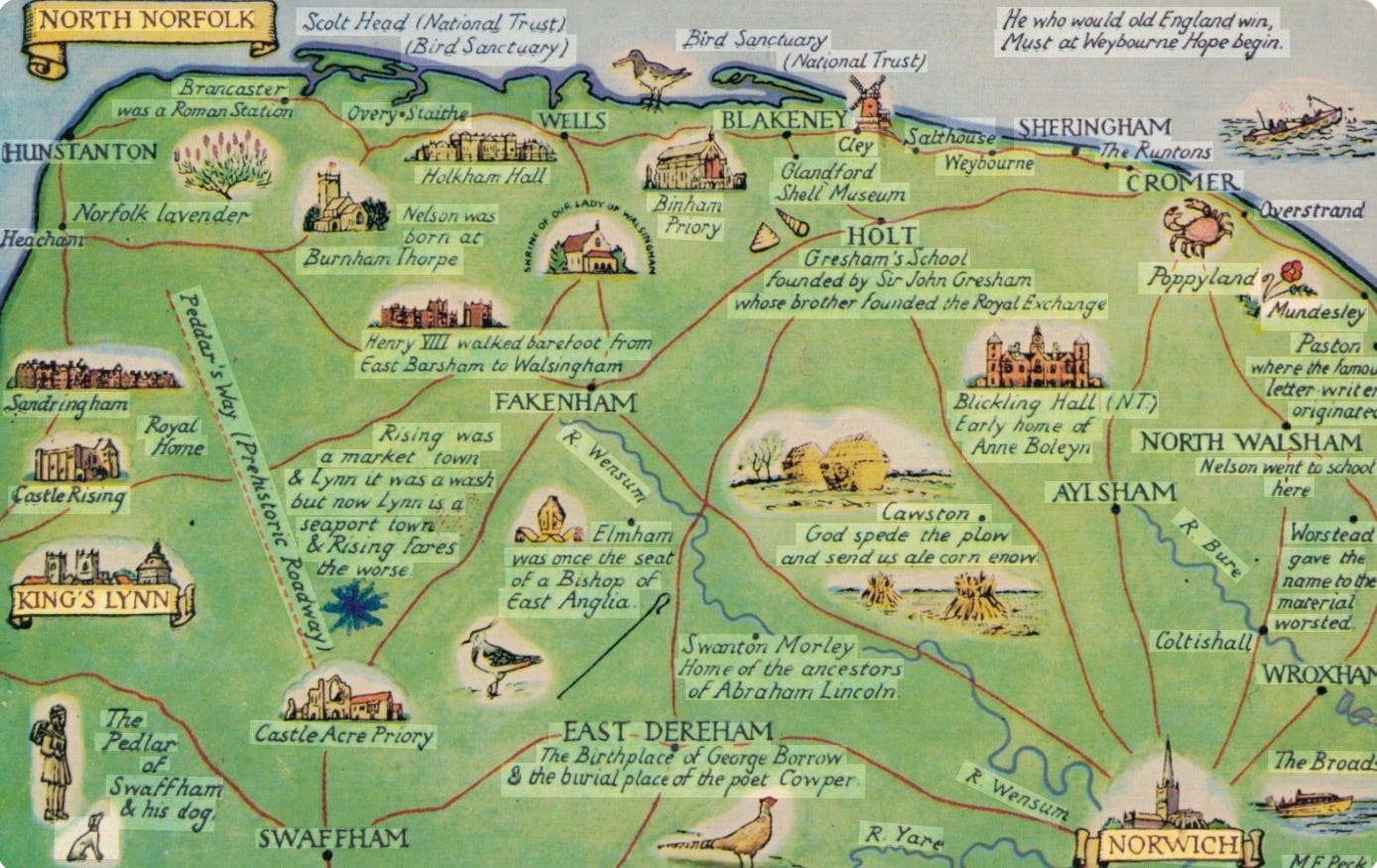
In 1981 I had the privilege of speaking in person with several dozen Norfolk residents about folklore, community traditions, and local history, all part of my research into the hyter sprites. Several of these informants volunteered themselves by responding to public calls I sent via the Eastern Daily Press, the East Anglian Magazine, and local Women’s Institute chapters across Norfolk. Others were referred to me – as best I can recall – by initial responders to the above, and via introductions made by individuals at the University of East Anglia, several other universities in the United Kingdom, and The Folklore Society.
I recently found my transcription of some of the taped conversations from January and February, 1981 – alas, the tapes themselves, and the transcripts from my November 1981 visit, are long since lost.
I offer here – with all necessary humility as I am an outsider – a summary of findings and some observations about the nature and use of Norfolk speech and specific dialect terms as related to me, along with notes about some of the local personalities and legends discussed. Not only was I a foreigner, the passage of nearly a half-century since I transcribed must also be noted, i.e., I trust my transcription for the most part, but I acknowledged even at the time how much I may have misunderstood, and my memory may reinforce error, or ignore mistakes, problematic in either case. Regardless, I hope that readers of Folklore Fieldwork, and Norfolk residents in particular, may find value in what I recorded as heard from the informants.
I compiled the following from my 1981 transcripts of conversations that year with three individuals in Martham (aged 73, 60, and 30 at the time), another individual (aged c. 68) in Martham, three individuals in Caister (all c. 60), one individual (aged 44) born & raised in Blakeney, and five individuals (aged 75, 75, 89, 94, and unknown; originally resident in Norwich, Horsford, and Melton Constable) interviewed at the Corton Hall Old Home in Norwich.
Pride in “Broad Norfolk”: The individuals I spoke with were proud, if occasionally a little bit defensive, about their accent and their use of Norfolk-specific terms. “Lots of wonderful words really.” “I like the Norfolk brogue but I do wish I could speak nicely too.” “In our childhood we were made … jokes were made about us and it was very bad to talk the Norfolk language!” “Isn’t it funny...the words you use? They aren’t in the dictionary.” One informant told of her granddaughter in the very recent past (late 1970s) being reprimanded by the girl’s schoolteacher not to use the word “mould” as that was not “standard English.”
Awareness of accent and dialect fading: “Most of the old broad Norfolk folk are died and gone; that’s dying out really.” “Different languages, things you used to learn, y’know, old Norfolk talkin’.” Essentially everyone referred to the advent of the radio and then television as having a big impact on speech patterns, likewise the greatly increased mobility with young people moving to London and elsewhere, and big-city people moving in or taking holiday homes.
Specific words used and discussed: “Wholly” (pronounced “hully”), as in “I wholly done that,” or “I wholly liked that.” “Dodman” (sometimes “doddiman”) for “snail.” “Mavis” for “thrush.” “Pissameer” for “ant.” “Mawther” for “woman” or “girl.” “Dwile” for “dish or dusting cloth.” “Bor” as an all-purpose part of greeting, a universal “you.” “Squit” for “nonsense.” Half the informants used the word “mardle” naturally, the others knew the word but did not use it. “Wim” as an instrument to harvest and/or open mussels was used by one informant, “snob” for “shoemaker” by one other, ditto “mivet” also for “thrush,” “moke” or “moe”for “a gull”, “thacking” (variant of “thatching”?). “Trossing” for “threshing,” and “trestle” for “threshold.” “Eel pick” and “butt [i.e., turbot] prick,” and “to speet the sprats.” “The churner-twist” –?, to which I appended the following in my transcription: “several words here which this American boy couldn’t understand.”
Nicknames: “Matter of fact, I never did know anyone in my youth who didn’t have a nickname.” “I don’t know how far it spreads, but everybody in my village had a nickname.” I heard many colorful examples. I also heard many nicknames for villages as a whole, eg.., Cess Rovers, Cromer Crabs, Wells Bitefingers, Sheringham Shannocks, possibly Doleydacks for folks from Hemsby. And every field had its own name.
The supernatural: “I don’t think many of the people out here could actually have very deep fears of the supernatural because they used to go out alone on these marshes, and they’re extremely ghostly places, and you wouldn’t go out there alone if you were afraid of anything like that and they used to work there day in and day out on their own.” No one claimed to believe in the following, but several were keen to talk about a ghost said to haunt the March Hare Pub (?) in Aylsham and a spectre seen at “a very old house near Diss” (NB: attached to buildings, not to the natural world). Most had heard of Black Shuck, but as something out of the past, no longer seen, a vague sense of a dog up near Blakeney and Cromer. Most agreed that one should never eat blackberries after October, because Satan had urinated and/or spat on them by that point. Several stated that one should never whistle at sea or misfortune would follow. One person said that swifts were known as “devil-birds.”
Unique and memorable individuals: Billy Bluelight came up frequently; one informant recalled that his catchphrase was “old sugar-my sock,” as he sold sweets and cough drops. Fascinating that a young informant told me Bluelight was a legendary figure from the 1800s; in fact, he died in 1949, and several of the older informants claimed they had met him. Long Arthur, an itinerant rag-and-bones man. Cracko Starling, who hunted and swallowed frogs. Blind Harry in Winterton. Professor Kessick the herbalist and phrenologist. Weary Willy Beck the poacher.
Very local places: Marshall’s Fish Factory (Great Yarmouth?). Timber Hill in Marsham (as distinct from the one in Norwich). Various explanations for the name “Mousehold Heath.” A tunnel or path between Salthouse and Cley. Wiveton Green, where allegedly a cannon is buried, creating a small mound to which Cromwell’s men were said to have tethered their horses.
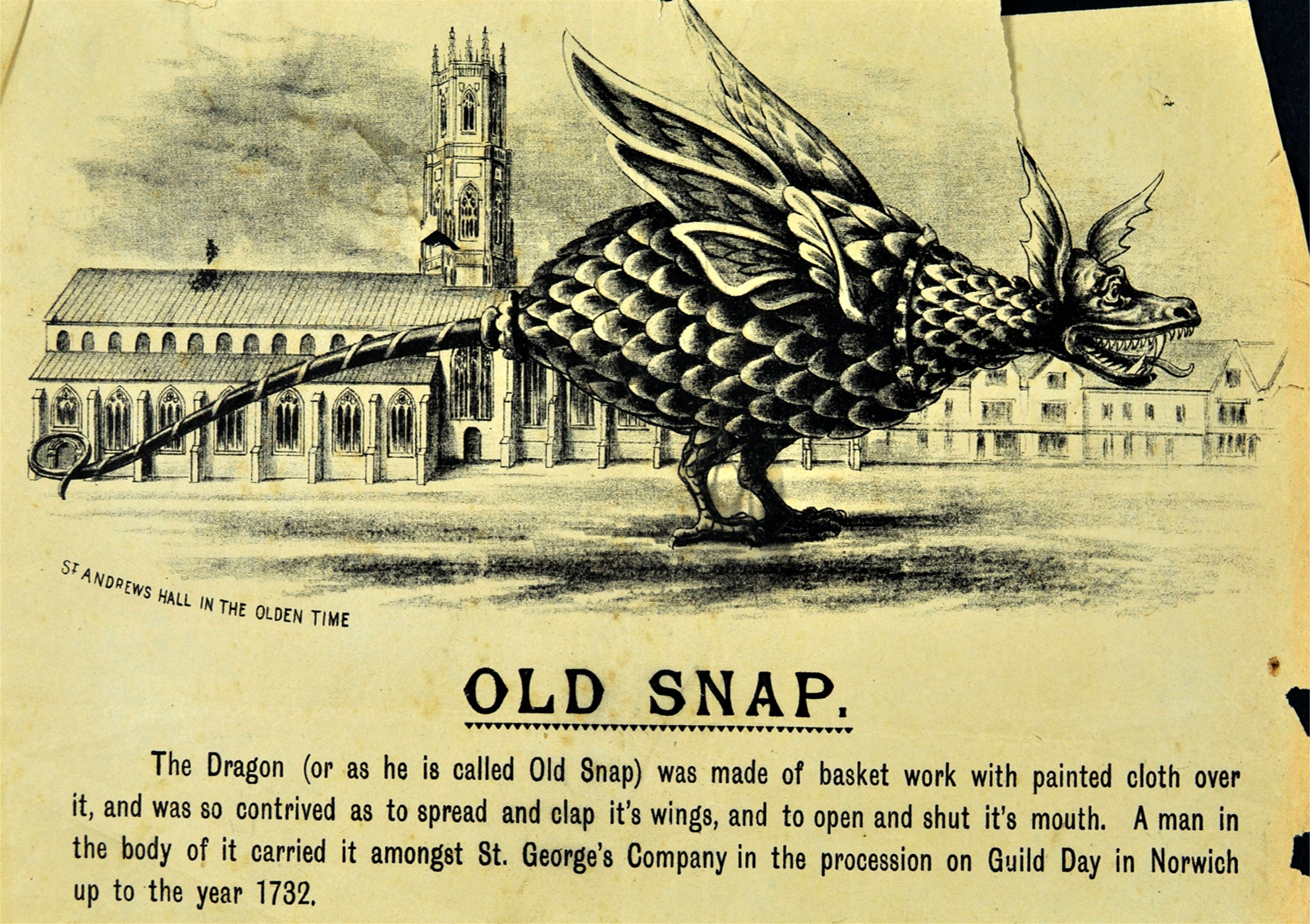
Miscellaneous bits of history: “Oner Cakemix” (?). Old Snap the Dragon being taken out and paraded through the streets of Norwich. Molecatching. Fossett’s Circus coming to Norfolk. Birdsnesting (one person said he loved that, but would never take a Robin’s or Wren’s egg because those species are “sacred”). The Great Flood of 1953. Lots about World War Two, especially about the American and Canadian airmen being stationed in East Anglia. One recollection of Zeppelin raids during the first world war. The General Strike of 1926. The oldest informants took pains to describe the first time they heard the radio or saw an automobile and an airplane – and many talked about how dark it was before streetlights came. Conversely, they had many memories of farriers and of blacksmiths.
Note: At the time I recorded these conversations, I relied in part on Broad Norfolk by Jonathan Mardle (i.e., Eric Fowler), and likewise on The Pattern Under The Plough, Ask The Fellows Who Cut The Hay, Where Beards Wag All, and other books by George Ewart Evans. Since then, I have benefited from the many works of Peter Trudgill (for instance, see here, and here), and the efforts of The Friends of Norfolk Dialect.
I’d like to thank Daniel Rabuzzi for this fascinating insight into the recent past. And as a current Norfolk resident I thought I’d throw in my two penn’orth on a couple of the subjects raised.
As is generally my bent, I am rather intrigued by the mention of the supernatural and am somewhat surprised by the apparent apathy towards Black Shuck. In recent years there have been several reports of sightings and Black Shuck Lore is shared frequently among locals. I too have heard mention of haunted pubs in Aylsham, not only the March Hare (now called The Unicorn), but also the Black Boys Hotel and The Bucks Arms next to Blickling Hall. And, as mentioned in previous articles, my husband’s family are Norfolk through and through, and one of his grandfathers spoke with a very broad Norfolk accent & used many dialect words. A couple that are still used frequently within the family are: bishy bishy barnaby = ladybird & rumun = wrong one, i.e. someone a bit dodgy, along with some of those mentioned above: dodman, dwile (of flonking fame) and ‘bour (known to us as a shortened form of neighbour). My husband recently mentioned an outlier, his other grandfather used to refer to a garden bonfire as a “gibby” but I cannot find any references to this being a Norfolk phrase. Has anyone else heard the term?
Daniel has promised me one last short note after this and we’re in for a treat: recollections of his meeting with George Ewart Evans (coming soon).
 | A guest post by
|
Fascinating